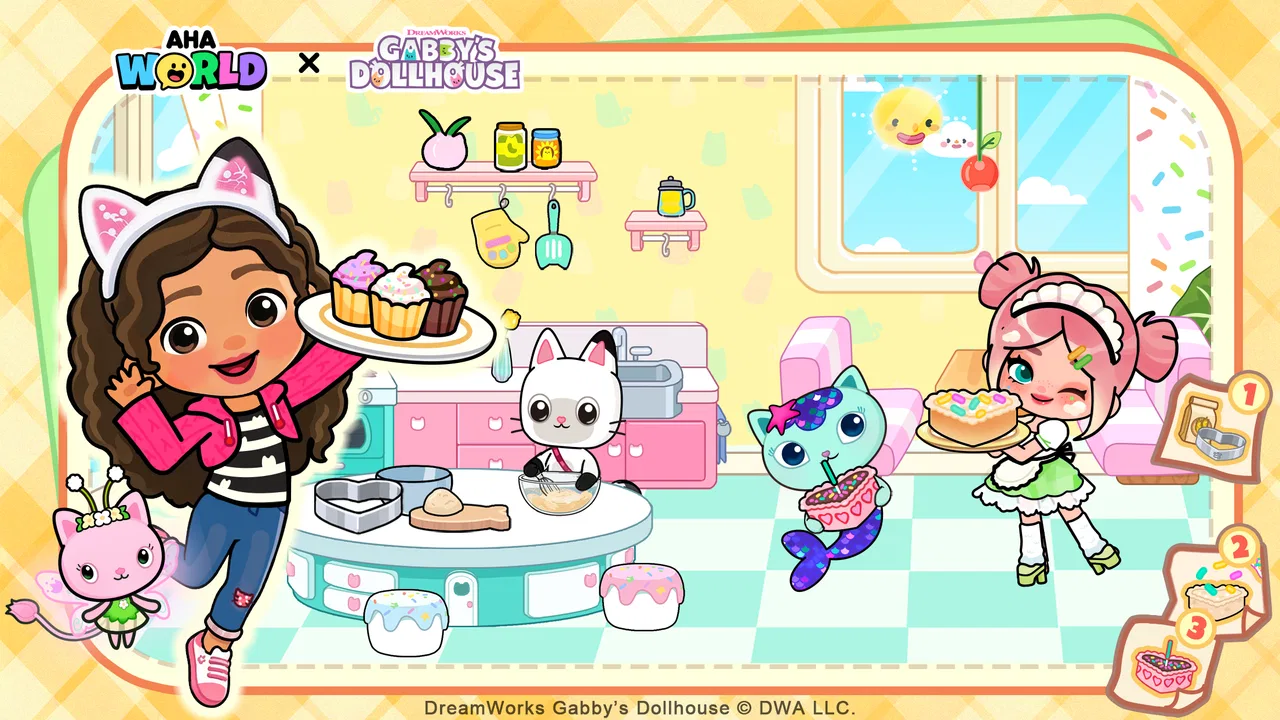
Aha World: Doll Dress-Up Game
- 4.6
- Rating
- 50.00M
- Installs
- Free
- Price

 Analysis by App-foxy
I spent time with Aha World as a dress-up and life-simulation game, paying particular attention to how comfortably different people can read, navigate, and take part. It is aimed at Everyone, and its appeal is easy to understand: instead of pushing the player through a fixed challenge, it gives them a playful world for creating characters, arranging scenes, and acting out everyday stories. That open-ended format can be welcoming for children who enjoy imagination more than competition, as well as for adults looking for a relaxed creative game.
My overall impression is positive, but with an important qualification. The game feels most accessible when the player is comfortable exploring colorful interfaces, remembering where objects are placed, and using touch controls without much assistance. It is less suitable for someone who needs highly explicit instructions, very restrained visual design, or a carefully structured learning path. In other words, the freedom that makes it enjoyable can also make it harder to understand.
How the world works for different players
I look at this section through a practical question: what helps one person join in without making another person take over? In my experience, agreeing on a small shared goal—then letting each player contribute through choices, suggestions, or touch—keeps the activity welcoming. That makes it easier to see why the same open-ended world can feel freeing to one player and uncertain to another.
You May Also Like

 Blood Strike: 2.5 Anniversary
Blood Strike’s Loadouts Turn Every Drop Into a Tactical Gamble
A close look at Blood Strike’s custom loadouts: how fast access to signature weapons reshapes its battle royale rhythm, rewards preparation, and narrows the gap between fights.

 Pandora - Music & Podcasts
Pandora’s Music Is Easy to Start, but Harder to Recover
Pandora’s strength is its low-effort path from a seed to a station. Its weak spot is how much confidence it asks you to place in connection, setup, and quiet recovery.

 8 Ball Pool
 Is Built on Rivalries, Rematches, and Routine
A close look at the rivalries, rematches, shared routines, and unanswered safety questions that turn a quick pool match into a persistent mobile community.

 Samsung Music
’s Quiet Strength Is Playing What You Already Own
Its reach comes less from spectacle than from dependable access to a personal library. That simplicity is both the app’s strongest retention engine and its ceiling.

 AccuWeather: Weather Radar
AccuWeather Review: A Quick, Clear Forecast for Everyday Decisions
For everyday plans, the best forecast is the one you can understand quickly. AccuWeather makes rain timing, radar, and local conditions easy to act on, with a few trade-offs.

 Hill Climb Racing
Why Hill Climb Racing Still Turns Crashes Into One More Run
A tiny car, a bumpy hill and one more upgrade: Hill Climb Racing keeps resurfacing because its simple chaos makes every near-miss feel personal.
More From Our News Desk
View All News


Readable presentation and navigation
The strongest part of the experience is its visual language. Characters, clothing, rooms, and interactive objects are presented as things to discover rather than as dense menus. I found that this makes the game approachable for players who understand pictures faster than long written instructions. A child can often recognize a room or an outfit by appearance and begin experimenting without needing to read a tutorial first.
That simplicity has a practical benefit in a family setting. If a child asks how to change a character’s appearance, an adult can usually demonstrate the action directly instead of explaining a complicated ruleset. I also like that the role-playing structure does not insist on one correct answer. A player can focus on dressing a character, arranging a scene, or inventing a small story, depending on what feels manageable that day.
Navigation is not completely effortless, though. A free-form world asks the player to remember where useful items and choices are located. Someone who expects a clear sequence of levels may wonder what to do next, while a player with attention or memory difficulties may lose track of an intended activity. The game’s lack of pressure is calming, but it also means that the player has to create their own direction.
My most useful approach was to choose one small goal before opening the game: create an outfit, set up a room, or act out a short scene. That prevents the large number of visual possibilities from becoming distracting. For younger players, an adult can turn this into a simple prompt such as “prepare a character for a rainy day” or “make a room for a new family member.” The prompt adds structure without taking away the creative freedom.
Text is not the center of the experience, which helps players who are still developing reading confidence. At the same time, that means the game should not be treated as a reading-focused educational tool. It is educational in the broader sense of encouraging imagination, choice-making, sequencing, and social storytelling, rather than teaching a clearly defined school subject.
One subtle strength is that the player can communicate an idea through arrangement. A child who struggles to explain a story verbally may still show it by choosing characters, clothing, and surroundings. I would not call this a replacement for communication support, but it can give families another way to invite conversation: ask what each character is doing, why an outfit was chosen, or what should happen next.
Touch, movement, and sensory load
The game depends on touch interaction, so the player needs to tap, drag, select, and move items with reasonable accuracy. That is natural for many mobile players, but it can be tiring or frustrating for someone with limited fine-motor control. Small targets, quick gestures, or repeated repositioning may require more effort than the relaxed presentation suggests.
I found that the open-ended design helps in one important way: mistakes usually feel harmless. If an object is placed somewhere unexpected, the player can try again rather than losing progress in a demanding challenge. This makes experimentation more comfortable for players who need extra time or who become discouraged by failure. The absence of competitive pressure is a real advantage for calm, shared play.
There is also a sensory trade-off. The colorful presentation can be inviting, but a busy screen with many characters, objects, and visual choices may feel intense for players who are sensitive to visual clutter. The same scene that looks lively to one person can be tiring to another. I recommend starting with a simple activity in a quieter setting rather than handing the game over during an already noisy or overstimulating moment.
Sound can matter just as much as the visuals, especially when the game is used in a waiting room, classroom, or shared family space. I would begin with the device volume low and adjust it based on the player’s comfort. That is a useful habit for any colorful mobile game, but it matters here because the experience is designed to keep attention on a changing scene rather than on one static puzzle.
A practical workaround for motor challenges is cooperative play. One person can describe the intended action while another handles the touch input. This does not make the controls accessible for everyone, but it turns the game into a shared storytelling activity instead of a test of individual dexterity. It also works well when a child wants to make a complex scene but finds repeated dragging tiring.
Players who rely on external input devices, screen magnification, spoken feedback, or other personalized tools should test the game on their own device before committing to extended play. I would not assume that a general Everyone rating means every control style will work equally well. The rating describes the intended age suitability, not a guarantee that every ability or support need is covered.
Using it at home, while traveling, and with other people
Aha World fits short, flexible sessions better than a strict routine. I can imagine using it after school when a child wants to decompress but is not ready for a competitive game. A parent might sit nearby, suggest a story prompt, and let the child make the decisions. Because there is no need to finish a level, the session can end naturally when attention fades.
It can also work during travel or waiting time, provided the device is prepared in advance and the player is comfortable with the interface. The game is free to download, which makes trying it less of a financial commitment. However, optional purchases range from $0.99 to $99.99 per item, so adults should review purchase settings before giving a child unsupervised access. The large difference between the lowest and highest listed item prices makes that preparation particularly important.
For shared play, I found that the best arrangement is not to let one person control everything. Give each player a role: one chooses the setting, another selects clothing, and another decides what the characters are doing. This makes the game more inclusive for a child who is less confident with touch controls, because participation does not depend entirely on moving objects quickly.
The game is also suitable for imaginative conversation between generations. An adult who does not normally play mobile games can still understand the basic appeal of dressing characters and building scenes. That makes it easier to join in without learning complicated controls. The experience is especially useful when the goal is connection rather than a high score.
On the other hand, it is not the best choice when a child needs a predictable, teacher-led activity with measurable steps. A conventional educational app may be better for practicing spelling, arithmetic, phonics, or a specific curriculum skill. A standard puzzle game may also be a better match for someone who prefers clear goals and immediate feedback. Here, the player supplies much of the purpose.
Where the inclusive experience still has limits
The biggest barrier is the gap between visual freedom and explicit guidance. Players who can infer what to do from pictures may feel at home, while players who need written directions, spoken explanations, or a consistent sequence may need help. I would introduce the game with a short demonstration rather than expecting every player to understand the structure immediately.
Another limitation is the dependence on personal device conditions. Screen size, touch sensitivity, brightness, and audio settings can change how comfortable the game feels. A small phone may make detailed interactions more demanding than a larger screen. Brightness that works in a living room may be unpleasant in a dark bedroom. These are not faults unique to this title, but they directly affect the experience because so much of the game is visual.
The free-to-play model also deserves attention from families. The initial cost is zero, but optional purchases can influence how the game is managed at home. I would explain clearly that extra content may cost money, set a device-level purchase restriction where appropriate, and decide whether the child can browse those options independently. This is part of making the game accessible in a broader sense: financial surprises can create a very different experience from the relaxed play the design encourages.
Updates can matter too. The current version is 4.31.0, and the minimum operating system is Android 9. That makes it important to check the device before planning to use the game with a child or in a group setting. A game that works well on one family tablet may not be equally comfortable on an older phone, and a device that cannot run it can become an access barrier before gameplay even begins.
I would also avoid assuming that the age label answers every family’s question. The Everyone rating makes the intended audience broad, but children differ in reading ability, attention, sensory preferences, and comfort with open-ended play. An adult’s first session is worthwhile, not because the game is dangerous by default, but because personal observation is the best way to judge whether the interface suits a particular child.
There is a further social limitation: open-ended role-play can be wonderful for one player and awkward for another. Some children enjoy inventing dialogue and stories, while others prefer an app to tell them exactly what happens. If a player keeps asking what the “right” action is, that may be a sign that a more structured game would provide a better experience. I would not push them to enjoy the freedom; I would switch to a format that matches their learning style.
What the game does especially well
In my experience, the most valuable feature is not a particular costume or room but the permission to play without being judged. There is no need to be fast, beat another player, or master a difficult rule system. That makes the game a useful low-pressure option for imaginative practice, especially when a child wants control over the story.
It is also good at turning ordinary situations into prompts for discussion. A scene can become a way to talk about getting ready, visiting a place, caring for someone, choosing clothes for weather, or resolving a small social problem. The game does not automatically teach those ideas, but an adult can use the player’s choices as an opening for conversation.
A second non-obvious strength is its usefulness as a transition activity. Because a session does not depend on reaching a final checkpoint, it can be stopped after a small creative task. I would use a timer or a verbal warning before ending, especially with a child who becomes absorbed in arranging details. The open format makes stopping easier than abandoning a competitive match, but it still helps to establish expectations.
A third strength is the way it supports different levels of participation. One player may make all the choices, another may offer suggestions, and a third may simply watch and comment. That flexibility is valuable in families or groups where abilities and confidence vary. It is not a substitute for dedicated accessibility tools, but it gives people more than one way to be involved.
Who should try it, and who should look elsewhere
I would recommend it to children who enjoy dolls, clothing, pretend households, and visual storytelling, especially when they prefer creating their own scenarios to following a fixed plot. It is also a good candidate for parents who want a calmer alternative to action-heavy games and are willing to participate during the first few sessions.
It may suit educators or caregivers as a conversation starter, but I would not present it as a complete classroom lesson. Its value comes from the stories players invent, so an adult needs to add questions, context, or a follow-up activity if the goal is deliberate learning. Without that guidance, it remains primarily a creative role-playing experience.
I would skip it for a player who wants deep strategy, precise progression, or a strong competitive system. I would also be cautious if the player has significant motor difficulties, strong sensitivity to visual busyness, or needs comprehensive spoken and text-based guidance. In those cases, a purpose-built accessible game or a more structured educational app may be the kinder choice.
The game comes from Aha World Ltd. and has reached over ten million installs, with a 4.7 average from around two hundred five thousand ratings and roughly three thousand five hundred written reviews. Those figures suggest that its broad, playful approach connects with many people, but popularity should not replace a personal fit check. A large audience can include many different experiences.
My inclusive verdict
I see Aha World as an inviting creative game with a genuinely useful low-pressure quality. Its visual presentation lowers the entry barrier for players who prefer showing ideas rather than reading instructions, and its open role-playing format allows families to adapt play around conversation, imagination, and different confidence levels. The best results come when an adult sets a small goal, manages sound and purchase settings, and treats cooperation as a valid way to play.
Its weaknesses are equally clear: navigation can be vague, busy scenes may overwhelm some players, and touch-based interaction can exclude people who need more precise accessibility support. The broad age rating should therefore be read as an invitation to explore, not as proof that every child will find the game comfortable.
For me, the deciding question is simple: does the player enjoy making choices without being told exactly what comes next? If yes, this free educational life-simulation game is worth trying, particularly for imaginative family sessions. If the answer is no, a more structured alternative will probably be more rewarding. Its inclusive value comes from flexibility, but that flexibility works best when the player has the support to turn an open world into a comfortable one.
FAQs for Aha World: Doll Dress-Up Game
01What is Aha World: Doll Dress-Up Game?
Aha World: Doll Dress-Up Game is a creative and interactive mobile app where users can design and dress up virtual dolls. It offers a wide array of outfits, accessories, and customization options, allowing users to express their creativity. The game is suitable for all ages and is available for both Android and iOS devices.
02Is there a cost to download or play Aha World: Doll Dress-Up Game?
Aha World: Doll Dress-Up Game is free to download and play. However, it does offer in-app purchases that can enhance the gaming experience by unlocking additional outfits, accessories, and features. Users can enjoy the basic features without spending money, but premium items may require purchases.
03What are the main features of Aha World: Doll Dress-Up Game?
The app provides a wide range of features including customizable dolls, various fashion outfits, and numerous accessories. It also offers themed events and challenges, allowing users to unlock special items. Additionally, the game supports offline play, making it accessible anytime and anywhere without an internet connection.
04Is Aha World: Doll Dress-Up Game suitable for children?
Yes, Aha World: Doll Dress-Up Game is designed to be family-friendly and is suitable for children. It encourages creativity and imagination through doll customization. Parents should be aware of in-app purchases and may want to monitor or restrict these features to avoid unintended spending.
05Can I play Aha World: Doll Dress-Up Game offline?
Yes, Aha World: Doll Dress-Up Game supports offline play. While some features, such as downloading new content or updates, require an internet connection, the core gameplay of dressing up dolls and customizing your world can be enjoyed without being connected to the internet.
Pros
- Diverse customization options for characters.
- Engaging and colorful graphics for all ages.
- User-friendly interface enhances gameplay.
- Regular updates with new content.
- No intrusive ads during gameplay.
Cons
- Limited free features without in-app purchases.
- Some items require lengthy unlocking.
- Occasional bugs in character animation.
- No offline mode available.
- Higher levels can be repetitive.

Aha World: Doll Dress-Up Game
Gallery